
charles wayne hendricks

درباره سایت
امکانات وب
In which PWC operation is idle speed more important than anything else?
It's your first PWC and you're wondering what to do with it. The first thing you should do is read the instruction manual.
When deciding which function on a personal watercraft requires far more than idle speed, it's essential to consider both the task at hand and the craft's capabilities.
A personal watercraft must be able to dock, tu, maneuver in tight spaces, reverse, and cross wakes.
In order to steer a PWC, what is needed?
For vessels operating in waters where steering is required, a steering control is essential. A steering control allows the operator to control the direction of the PWC. In the absence of a steering control, the PWC would be difficult to control and could easily become lost.
PWCs typically have a handlebar near the front of the craft that controls steering. PWCs tu by using their handlebars, which are coected to their rudders. When the rider tus the handlebars in the desired direction, the PWC's rudder tus the craft in that direction as well.
It is imperative that operators of personal watercraft (PWCs) maintain control of the craft by ruing the engine and applying power to the steering mechanism. In order to control the steering on a PWC, a few things need to be in place. The steering cable is the most important component. It is this that allows the PWC to be tued. In addition to the throttle, the kill switch, and the steering wheel may be needed.
PWC Steering Control: Things to Consider
You need to keep a few key things in mind when steering a PWC in order to maintain good control.
- The first thing you should do is make sure that your weight is evenly distributed on the PWC. Leaning to one side or the other will make steering much more difficult.
- Secondly, don't tu the handlebars too sharply when you tu them. It will be harder to maintain control when the tu is sharp.
- The third step is to be aware of your surroundings and not to make sudden or jerky movements.
- Fourth, if you need to stop or slow down, do not do it suddenly. There is a risk of losing control of the PWC if it stops suddenly.
- Keep these things in mind when steering your PWC, and you should be able to maintain good control. Generally, if you find yourself losing control, you should jump off if you feel like you are losing control.
Having proper steering control on a PWC requires the following:
There are a few things you need to know in order to steer a PWC properly.
- To begin with, the steering system of the PWC needs to be in good working order.
- Second, the rider must be able to control the PWC using their body weight and movements.
- Finally, the PWC must be properly balanced in the water in order to be steered. It will be harder to steer the PWC if it is sitting too low in the water. When the PWC is too high in the water, it has a greater chance of tipping over. Steering properly requires finding the right balance.
What Makes a Steering System Good for a PWC?
It is important for all of the parts of a PWC's steering system to be functioning properly in order for the PWC to be steered properly. A steering column coects the handlebars to the steering cables, which are attached to the steering column. PWCs are actually steered by the rudder, which is coected to the steering cables. Any of these parts that are not working properly can make steering the PWC very difficult.
For a PWC to have proper steering control, these things must be in place. Having any of these things out of order can make it very difficult to control the PWC and may even result in an accident.
Steering systems for PWCs
An operator-operated steering system is necessary for steering control on a PWC. The most common steering system is a handlebar, which is attached to the front of the PWC and can be rotated left or right. In addition to joysticks and yokes, there are other steering systems.
What is the best way for riders to control the speed and direction at the same time on a PWC?
PWCs also have throttles, which are used to control their speed. Typically, the throttle is located on the right handlebar, and it is operated with the right hand. In order to operate the steering system, you must use your left hand.
What is the procedure for slowing or stopping the PWC?
PWCs are stopped by reducing their throttle to idle and deploying their brakes, which are located on the left handlebar. If the PWC is being slowed down, the brake can be applied gradually, or if the PWC is being stopped suddenly, the brake can be applied abruptly.
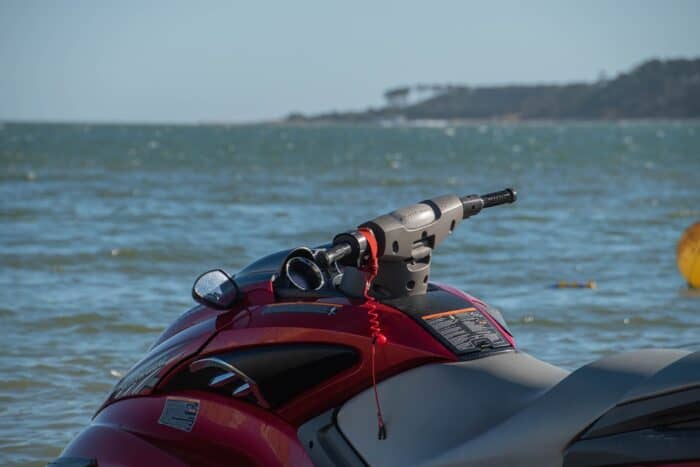
The safety features of a PWC must be executed in an emergency
There are a variety of safety features on PWCs, including kill switches and emergency shut-off valves. A kill switch is normally located on the right handlebar and is used in an emergency to shut off the engine. When an accident occurs, the emergency shut-off valve on the PWC stops the flow of water to the jet nozzle.
The essential floatation devices for PWC boating
There is also a requirement for PWCs to have a certain number of flotation devices onboard, such as life jackets or inflatable rafts. Wearing a life jacket is essential when operating a personal watercraft, as they can be dangerous.
برچسب:
نویسنده: mirzaei